
What Is a Fixed-Wing Aeroplane?
Fixed-wing aircraft generate lift through wings that are rigidly attached to the airframe, rather than rotating or flapping. The category covers everything from basic training aeroplanes and gliders through to commercial airliners. If you are thinking about learning to fly in the UK, a fixed-wing aeroplane is almost certainly what you have in mind.
The Main Parts of a Fixed-Wing Aircraft
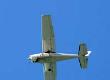
Whatever type of fixed-wing aircraft you fly, the same fundamental components will be present. Understanding what they do and why they matter is a core part of your ground training, and questions on aircraft technical knowledge appear in the CAA theory exams you will sit for any pilot licence.
- Fuselage. The main body of the aircraft. It houses the cockpit, passenger seating, flight instruments and, on single-engine types, the engine itself. Fuel is sometimes stored here too, though wings are the more common location.
- Wings. Far more than simple lifting surfaces. Wings contain fuel tanks, house control surfaces such as ailerons and flaps, and are shaped using aerofoil profiles to generate lift efficiently. Flaps increase wing area during take-off and slow-speed flight, and are used to steepen the approach for landing without increasing airspeed. Slats, slots and spoilers are found on more complex aircraft, particularly commercial jets.
- Vertical stabiliser. The upright fin at the tail, which provides directional stability and resists yaw. The rudder is hinged to its trailing edge.
- Horizontal stabiliser. The smaller, wing-like surface at the tail that controls pitch, meaning whether the nose rises or falls. On most light aircraft this is a fixed tailplane with a moveable elevator attached. Delta-wing designs such as Concorde dispensed with this arrangement entirely.
- Engine or engines. Piston engines are standard on most training aircraft and many light aeroplanes. Jet engines are used on faster and heavier types. Engine position varies: nose-mounted on most single-engine trainers, wing-mounted on twins and larger aircraft, and sometimes tail-mounted. The configuration determines whether the thrust pulls or pushes the aircraft forward.
- Landing gear. This may be wheels, floats or skids depending on the operating environment. Wheel configurations include the tricycle layout, which is the most common on modern training aircraft, with a nosewheel and two main wheels under the wings. Tail-wheel or taildragger types, such as the de Havilland Chipmunk and the Piper Cub, have the main gear forward of the centre of gravity and a small wheel at the rear. Landing gear can be fixed or retractable. Fixed gear is standard on training aircraft; retractable gear reduces drag on higher-performance types and is a rating you will need to obtain separately once licensed.
Pilot Training Cost Calculator
Work out what learning to fly really costs: get a realistic UK estimate for your licence, broken down into flight hours, instruction, exams, medical and test fees, so there are no surprises.
Try our Pilot Training Cost Calculator free, here on this site →What Licence Will You Be Working Towards?
In the UK, the two most relevant licences for private fixed-wing flying are the Light Aircraft Pilot Licence (LAPL) and the Private Pilot Licence (PPL). Both are issued under UK CAA regulations.
The LAPL requires a minimum of 30 hours of flight training, of which at least 15 hours must be with an instructor. It restricts you to single-engine piston aircraft with a maximum take-off weight of 2,000 kg, and you may carry no more than three passengers. It is valid within the UK and many other countries, though you should check reciprocal acceptance before flying abroad.
The PPL requires a minimum of 45 hours total flight time, including at least 25 hours dual instruction and 10 hours supervised solo. It gives you wider privileges, including the ability to fly single-engine aircraft across Europe and beyond, and acts as the foundation for add-on ratings such as instrument flying, aerobatics and multi-engine. Realistically, most students complete the PPL in 55 to 70 hours. At current UK rates of roughly £180 to £250 per hour for a training aircraft and instructor, total costs typically fall between £10,000 and £15,000, though this varies by school and aircraft type.
Both licences require you to pass nine CAA written theory examinations covering subjects including Air Law, Navigation, Meteorology, Human Performance, Principles of Flight, Aircraft General Knowledge, Flight Performance and Planning, Operational Procedures, and Communications.
Your situation may be slightly different. ask a question below ↓ and our editorial team will reply with our advice.
Medical Requirements
The LAPL requires an LAPL medical, which is a straightforward examination carried out by a CAA-approved Aeromedical Examiner (AME) or in some cases your GP. The PPL requires a Class 2 medical, which is more thorough and must be conducted by a CAA-approved AME. If you have any existing medical conditions, it is sensible to arrange the medical early in your training rather than after spending money on flight hours. The CAA medical team can provide informal guidance before you commit.
What Fixed-Wing Flying Requires on the Ground
Fixed-wing aeroplanes need a runway or at least a cleared strip of adequate length for both take-off and landing, with obstacle-free approaches at each end. This is one practical difference from helicopters and gyrocopters, and it shapes where you can operate. Most UK flying clubs are based at licensed aerodromes or registered airfields, and your training school will give you a clear picture of the local area and airspace you will be working within from day one.



Ask Start to Fly a question
Ask our editorial team a question and we will reply with our advice. Tell us as much about your situation as you can: the more detail you give, the more useful our answer can be.
You do not need to use your real name. Please do not include your full address, phone number, email address, or the names of other people. We may edit or remove identifying details for privacy and legal reasons.
Comments are moderated before publication.